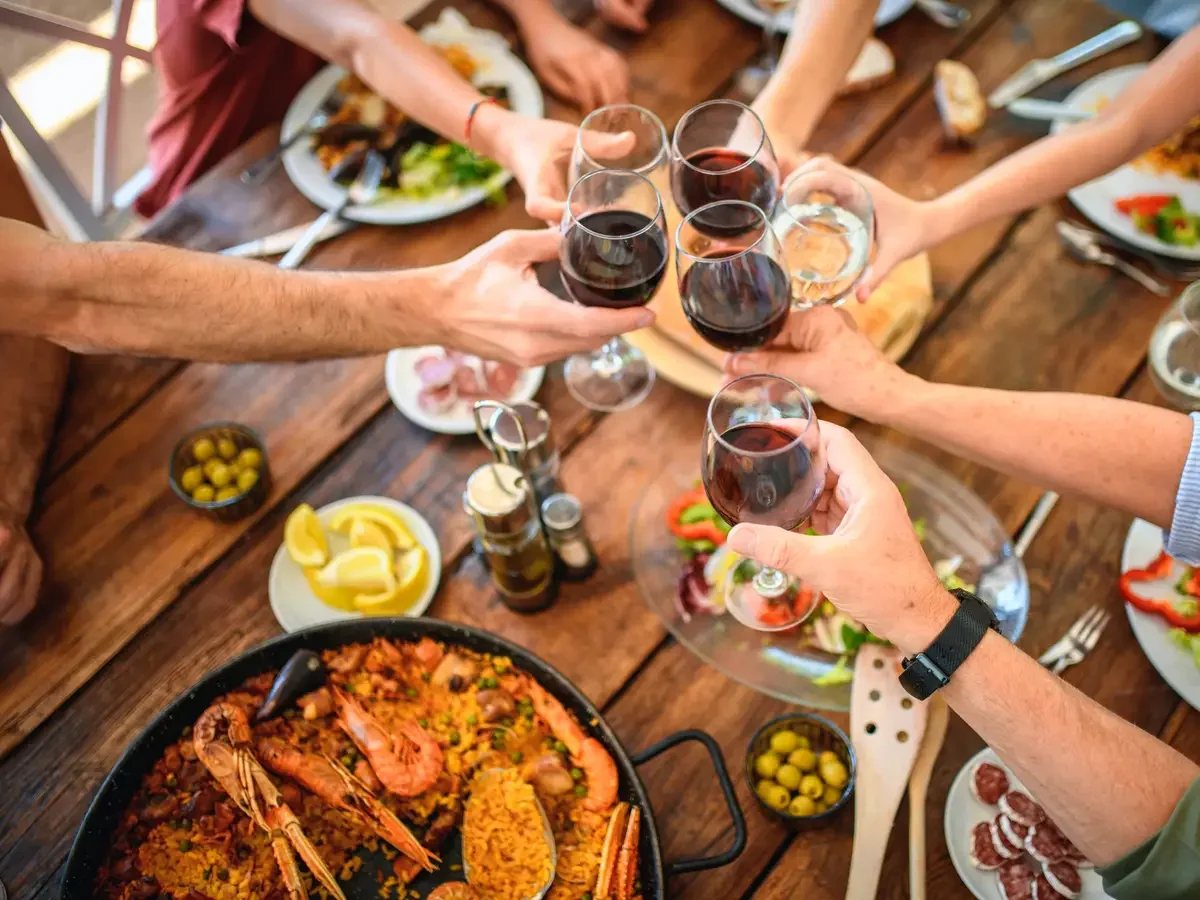
What the world's longest-lived people know about wine, community, and the table, that modern health headlines keep missing
The headlines arrive with the certainty of verdicts. “No safe level of alcohol,” they declare. “Even one drink a week raises cancer risk.” Public health agencies have revised their guidance downward, and the moral calculus around wine — once a symbol of the good life — has shifted dramatically. But before we empty the cellar and repent at the dinner table, it is worth pausing with a quieter question: are we measuring the right things?
The research casting all alcohol as categorically harmful is real, and it deserves serious attention. But there is an equally serious body of evidence, drawn not from controlled trials but from the actual lives of the world’s oldest and healthiest people, that tells a more nuanced story. A story not really about alcohol at all. A story about how we eat, who we eat with, and how slowly we allow ourselves to do it.
Where a glass of wine is just part of living
Beginning in the early 2000s, National Geographic explorer Dan Buettner led teams of demographers, scientists, and anthropologists to corners of the earth where people were routinely and robustly living past the age of one hundred. They called these places Blue Zones. What they found was not a supplement regimen or a calorie protocol. It was a way of life — and in four of the five zones, that life included wine. Watch the Documentary here
Sardinia, Italy Home to the world’s longest-lived men. Shepherds carry Cannonau wine into the hills daily, alongside bread and beans.
Ikaria, Greece A sun-soaked island where residents “forget to die.” Wine flows at social gatherings and long, slow dinners.
Nicoya, Costa Rica Moderate alcohol, shared in the late afternoon, is woven into the social fabric of the peninsula’s elders.
Okinawa, Japan Home to the world’s longest-lived women. Tight-knit social bonds, the moai, define daily life.
The Blue Zones research distilled these commonalities into what Buettner calls the Power 9, and one of them, "Wine at 5," is precisely what its name suggests. Among centenarians in these regions, the habit of taking one to two glasses of wine in the late afternoon, almost always in good company and nearly always alongside food, appears consistently associated with longer lives.
Sardinia’s contribution is particularly striking. The region’s native Cannonau wine, made from Grenache grapes whose thick skins remain in contact with the juice during fermentation, has been shown to contain two to three times the antioxidants found in most other wines. Sardinian shepherds have carried it into the hills for centuries, not as indulgence, but as provision.
It was never just about the wine
Here is where the nuance becomes essential and where the modern alcohol debate tends to go astray. The Blue Zones research is emphatic on this point: wine consumed alone, in quantity, or as compensation for an otherwise unhealthy lifestyle confers no benefit. The habit is completely inseparable from its context.
Research context
Scientists who study Blue Zone longevity note that the benefits appear to lie not in the alcohol itself, but in the ritual surrounding it. In these regions, wine is consumed within an overall Mediterranean dietary pattern rich in beans, greens, whole grains, and olive oil alongside community, purposeful stress relief, and shared meals.
This brings us to what may be the most under appreciated finding in the entire body of longevity research: the profound, measurable, life-extending effect of eating together. Researchers call it commensality, the sharing of food in a social environment, and the data behind it is extraordinary.
A widely cited study in the journal Evolutionary Psychology found that people who eat socially more often feel happier and more satisfied with life, are more trusting of others, are more engaged with their communities, and have more friends they can depend on. Shared evening meals involving laughter, reminiscing, and yes -wine- were the experiences most strongly associated with closeness to others. The researchers concluded that social eating may have evolved precisely as a mechanism for building the bonds that keep us alive.
Loneliness kills. The table heals.
In 2025, the World Health Organization’s Commission on Social Connection made the stakes plain. Social isolation and loneliness increase the risk of stroke, heart disease, diabetes, cognitive decline, and premature death. People who are lonely are twice as likely to become depressed. An analysis of 148 studies found that people with strong social bonds had a 50 percent greater chance of survival than those with poor social relationships.
We are, the science keeps insisting, wired for the table. And yet in our era of individual nutrition optimization, of tracking macros, fasting windows, and inflammation markers, we have largely stopped asking who is sitting across from us while we eat.
“Positive relationships trigger a cascade of physiological responses that benefit your health. When you feel loved, supported, and connected, your body releases hormones like oxytocin, dopamine, and serotonin.”
The Blue Zones elders did not optimize. They gathered. They lingered. In Sardinia, sitting down together each evening is not a wellness strategy but it is simply the texture of life. The wine in those evenings is not incidental. It is part of what makes the meal unhurried, what makes the conversation go long, what signals to the nervous system that this moment is one of rest, not urgency.
Slow food, good wine, and the wisdom of the table
The Mediterranean table is not an aesthetic choice. It is, increasingly, a medical recommendation. The dietary pattern it embodies (heavy with vegetables, legumes, olive oil, whole grains, and fish; light on meat and processed food) is the most extensively studied in the world, consistently associated with reduced cardiovascular risk, lower rates of metabolic disease, and greater longevity.
Research published in Advances in Nutrition found that wine consumed as part of a Mediterranean-style diet could reduce the risk of cardiovascular disease and certain cancers. The combination appears to matter: wine alongside a meal rich in flavonoid-containing vegetables and olive oil allows the body to absorb more of those beneficial compounds than it would from food alone. Context, again, is everything.
Then there is the matter of pace. The Okinawan tradition of hara hachi bu, stopping when you are eighty percent full, has been widely noted. We often reference this at home after watching ‘Live to 100 - Secrets of the Blue Zones documentary series. But less discussed is the mechanism. A meal eaten slowly, in pleasant company, with pauses for conversation and perhaps a glass of wine, naturally extends over time. The hormones that register fullness take twenty minutes to peak in the bloodstream. Slow dining is, in a very literal biological sense, a weight-management strategy. The table is not the enemy of health. It may be one of its oldest medicines.
An honest caveat
The research here is genuinely complex. Critics of the Blue Zones work point out that moderate drinkers in observational studies are often more socially connected, financially stable, and generally healthier to begin with, making it difficult to isolate the effect of wine itself. Some recent analyses have challenged whether longevity benefits in these regions are as directly tied to alcohol as earlier summaries suggested.
These are fair points. The argument here is not that wine is medicine, or that abstainers are wrong. It is that a glass of good wine, shared with people you love, over a meal of real food, eaten without rush is a practice with deep human roots and meaningful evidence behind it. The risk of that particular picture appears to be quite small. The reward, measured in pleasure and connection, is harder to quantify but impossible to dismiss.
A glass, some friends, no hurry
The modern health conversation is not wrong to scrutinize alcohol. Abuse causes profound harm, and there are individuals for whom any consumption is inadvisable. Public health guidance must account for populations in aggregate, not for the idealized Sardinian shepherd walking the hills at eighty.
But we lose something important when we flatten the nuance. When we treat a single glass of Grenache shared over a long dinner with old friends the same as a nightly bottle consumed alone in front of a screen. One of these practices belongs to a life that the evidence consistently tells us is a long one. The other does not.
The Blue Zones are not asking us to drink. They are asking us to slow down, gather around a table, fill our plates with food grown from the earth, and look each other in the eye. If a glass of wine is the ritual that makes those things happen more reliably in your life that lengthens the meal, lowers the shoulders, opens the conversation, then it is earning its place.
Pour thoughtfully. Eat slowly. Stay at the table longer than you think you should.
These are not indulgences. They are, it turns out, medicine of a very old and well-tested kind.
note on sources: This article draws on research from the Blue Zones Project (Buettner et al.); Evolutionary Psychology (Dunbar, 2015) on commensality; the WHO Commission on Social Connection (2025); studies on Mediterranean diet and cardiovascular risk in Advances in Nutrition; and University of Florida research on aging and social connection. Wine in moderation is not appropriate for everyone. Those with a history of alcohol dependence, certain medical conditions, or pregnancy should follow the guidance of their physician.