Peace, Bread, Land, Wine: The Living Legacy of Brooks Wine
Some wineries make good wine and some wineries tell a good story. And then there are wineries where the story and the wine are so thoroughly the same thing that you can’t separate them and where every bottle carries the weight of something real. Brooks Wine in Willamette Valley is the third kind.
We’ve been enjoying Brooks wines for years, but the more I’ve learned about who they are and how they farm, the more I’ve come to understand that what’s in the glass is really the least of it. The most interesting thing about Brooks is everything that had to happen just for the winery to still exist.
The Man Who Started It All
Jimi Brooks was a visionary Portland native who came to wine through his passion for history and philosophy. He wasn’t a winemaker first but he was a thinker, a traveler, a person drawn to ideas and the places that shaped them. He spent a decade in Europe before moving back to Oregon in the 1990s, devoting his life to holistic farming. What he found in Beaujolais, the idea that farming could be a philosophy, that the way you treat the land is inseparable from what the land gives back, followed him home.
In 1998, Jimi Brooks started Brooks Winery, focusing on Oregon’s potential for expressive, complex, and balanced Riesling and Pinot Noir. He was early. He was passionate. And he was certain, in a way that makes more sense looking backward than it did at the time, that the Willamette Valley was capable of something exceptional.
“If the vine is happy, the grapes simply taste better. I believe that farming in this way, by keeping the earth alive and the ecosystem intact, is the only way to really achieve that concept of terroir.” Those are Jimi’s words. They’re also, as it turns out, the founding document of everything Brooks has become.
What Friendship Can Do
Jimi passed away unexpectedly in 2004 at the age of 38. Two weeks before harvest.
What happened next is the part of the Brooks story that genuinely moves me every time I revisit it. When Brooks died, his fellow winemakers banded together and made the wines. They persuaded Jimi’s sister, Janie Brooks Heuck, to abandon her business career and take over management of the winery to keep her brother’s dream alive. A dozen of Oregon’s top winemakers gave their time, their skill, and their grief to make Jimi’s 2004 vintage in his signature style.
Jimi’s winery was left to his sole heir, Pascal, his then eight-year-old son. An eight-year-old became the owner of a winery. And the community that Jimi had given himself to, the close-knit, generous, idealistic world of Willamette Valley winemaking, circled around that child and kept the lights on.
Chris Williams became the full-time winemaker at Brooks in 2005. He and Jimi had met in 1997, over motorcycle parts, and bonded over wine working alongside each other at WillaKenzie Estate and Maysara before Chris joined Brooks. He has continued Jimi’s gentle approach to winemaking, his commitment to biodynamic farming, and his desire to express the terroir of the Willamette Valley through the wines. Today, winemaker Claire Jarreau has taken the helm, carrying that same tradition forward with equal care and reverence for the land.
That’s the architecture of Brooks: a family-owned, fiercely independent winery where care, inclusivity, and kindness are the way of doing business. More than 75% of Brooks’ managerial team identifies as women. That’s not an afterthought — it’s the culture Janie built, quietly and deliberately, over two decades of stewardship.
How They Farm
This is the part that speaks directly to the Cork Dork in me, and honestly, to anyone who believes that wine begins long before the cellar.
Brooks Winery came to life in 1998, after founder Jimi Brooks had spent time in France, where he worked with wineries using biodynamic farming principles in their vineyards. Seeing parallels between these processes and the resulting healthier, better-tasting fruit, when he returned to Oregon and started his own label, the awareness that everything growing in the ground is a reflection of everything else in its environment became a key element of his approach.
Brooks has been committed to biodynamic farming and winemaking since 2002, and became Demeter® certified in both the vineyard and the winery in 2013. Biodynamic farming goes beyond organic. It treats the farm as a living organism, a self-sustaining ecosystem where nothing is added from outside that the land can’t absorb and give back. Brooks utilizes strategies that emphasize prevention of disease and insect control including botanical species diversity, predator habitats, balanced crop nutrition, cover crop rotation, and maintaining colonies of honey bees on site.
Brooks farms twenty acres in the Eola-Amity Hills, a sub-region of the Willamette Valley characterized by higher altitudes and the ocean winds that blow through the Van Duzer Corridor. Those winds matter as they’re the cooling mechanism that allows grapes to ripen slowly, building complexity rather than chasing sugar. It’s the same principle behind so many of the world’s great wine regions: stress the vine just enough, and it reaches deeper, works harder, becomes more itself. Doug spoke to this in a recent article.
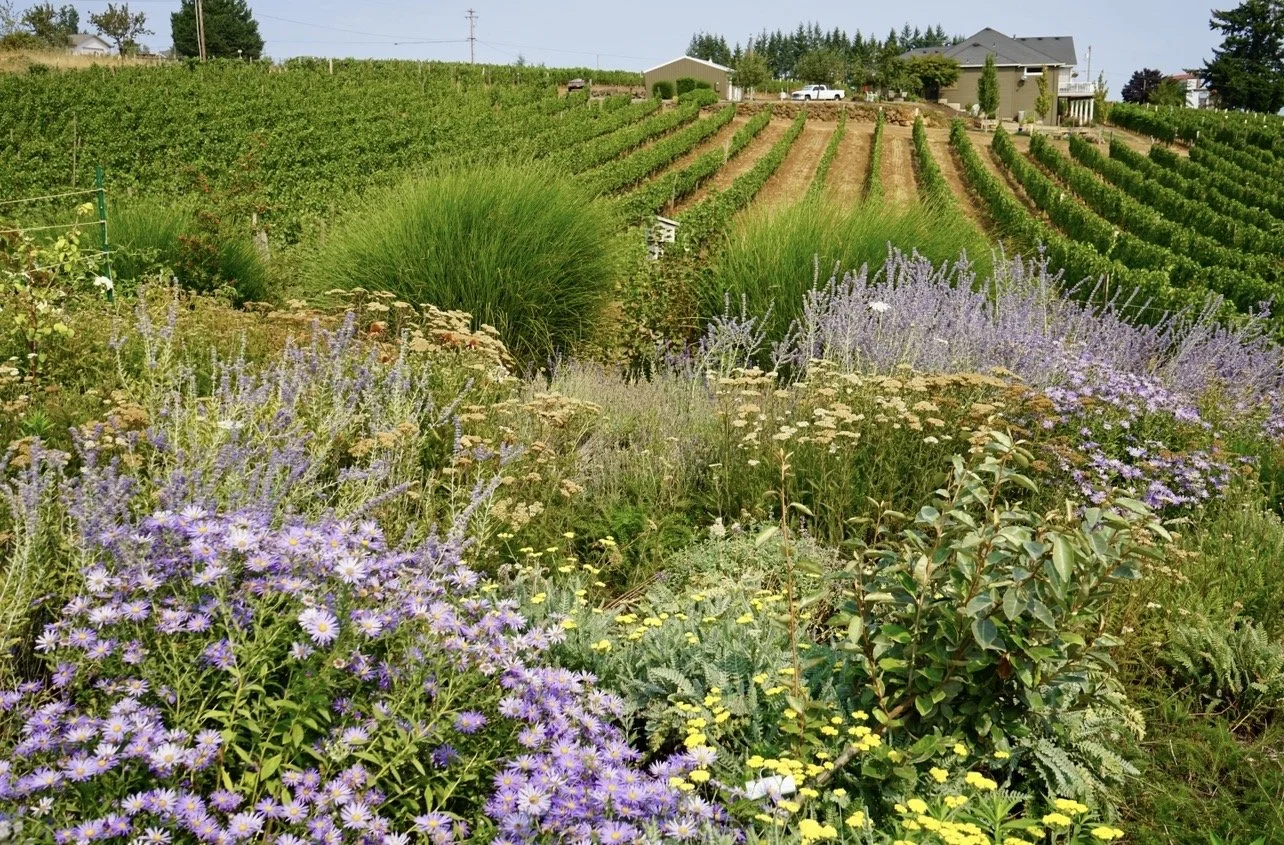
A walk through Brooks’ sprawling biodynamic garden will have you crossing paths with happy and buzzing pollinators making their way to and from colorful flower flumes to be found everywhere. Brooks has gone beyond biodynamic requirements in the promotion of health and prosperity for local pollinators, including the planting of insectaries, wildlife corridors, and a focus on species diversity. Their organic garden supplies the kitchen with herbs, vegetables, and cut flowers. Their eggs come from chickens fed organically. Anything they can’t get on the grounds is sourced locally.
This is what it really looks like when someone means it.
The Wines Themselves
Brooks produces 20,000 cases across 60 different labels, with a focus on Pinot Noir, Riesling, and other aromatic whites. The breadth is part of the philosophy. Jimi believed that Riesling was capable of something exceptional in Oregon, and he was right. Brooks produces more Riesling than any other winery in America, with offerings ranging across dry, medium-dry, medium-sweet, and sweet styles, including single-vineyard designates and sparkling.
The current releases reflect just how far that vision has traveled. The 2024 ‘Ara’ Riesling (made in the Trocken style) is bone dry, with silky texture and refined mouthfeel, dense citrus and melon fruits combined with shades of salted French bread (I said what I said), and an astonishingly good lingering finish. The Pinot Noirs are equally compelling: the 2024 ‘Rastaban’ Pinot Noir comes from estate vines first planted in 1973, arriving mineral-laden and lush with a refined mouthfeel, loads of red and dark fruits filling the palate alongside damp earth and rocky soil nuances.
These are wines that taste like somewhere. I know we talk about this often, and that’s the whole point.
At the Table
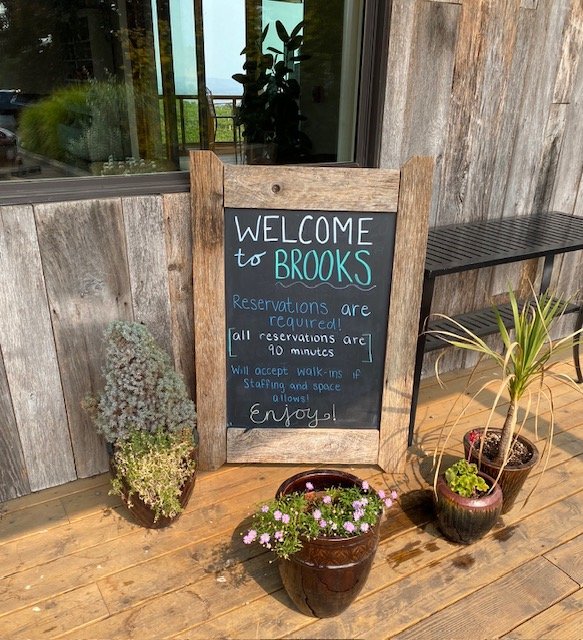
One of the things I love most about Brooks is how seriously they take the table alongside the glass. The winery features a full kitchen that offers food pairings to complement the wines, with breathtaking views of four mountains on clear days. We’ve been fortunate to enjoy this experience and it was nothing short of incredible.
Their pairings are intuitive rather than formulaic, the kind that make you reconsider what you thought you knew. The Ridgecrest Riesling paired with a cold soba noodle cucumber salad. The Royer Riesling alongside house-made fettuccine with lemon cream and ham. A lamb meatball hoagie with sheep milk cheese and mint salsa verde paired with a single-vineyard Pinot Noir. This is wine as context, not as afterthought.
For the Rieslings specifically, think beyond the obvious. The range of styles, from bone-dry to lusciously sweet, means there’s a Brooks Riesling for nearly every course. Dry Riesling with Pacific Dungeness crab, halibut, or a simple roasted chicken. Off-dry with Southeast Asian-spiced dishes where the residual sweetness is a gentle counter to heat. The sweeter styles alongside blue cheese, fruit tarts, or simply on their own as the last thing you taste before bed.
The Pinot Noirs, true to Willamette Valley form, are built for salmon. But they’re also quietly extraordinary with mushroom risotto, duck breast with cherry reduction, or earthy lentil dishes that welcome the wine’s terroir-driven depth.
What Brooks Has Become
Brooks is the only winery in the world that is a Certified B Corporation, a member of 1% For the Planet, and Demeter Biodynamic certified. That triple designation is not a marketing strategy. It is, taken together, a complete and coherent philosophy about what a business owes to the people who work in it, the community surrounding it, and the land it draws from.
Brooks has partnered with Ecologi to plant trees with every order, every club anniversary, and at special moments throughout the year. As a member of 1% for the Planet, Brooks donates 1% of annual revenues to support environmental efforts.
Pascal Brooks, now grown, carries his father’s guiding philosophies. Peace, Bread, Land, and Wine in the years since his father passed. Those four words appear on every Brooks bottle. They’re not a tagline. They’re a eulogy that became a mission statement, and then became a winery.
Some bottles of wine are just wine. And some carry something harder to define. A story, a loss, a community that refused to let a dream die, a piece of land tended with something closer to reverence than agriculture.
Brooks is the second kind. Open a bottle and you’ll taste what I mean.